

How to Plant Corn Seeds for Farmers Like a Pro
Planting corn seeds the right way boosts your chances of a great harvest. Did you know planting late can cut yields by 0.35 bushels per acre? Studies also show uniform spacing and timing can increase yields by up to 9%. Mastering how to plant corn seeds is your first step to success.
Plant Corn Seeds with Unmatched Precision Using FJD AT2 Auto Steer System
When it comes to planting corn seeds, straight rows are critical for maximizing yield and ensuring uniform growth. The FJD AT2 Auto Steer System delivers unmatched accuracy by automatically guiding your tractor along precise straight lines, even in challenging field conditions.
With advanced GNSS technology and real-time steering corrections, the AT2 system minimizes overlap and skips, saving you seeds, time, and fuel. Whether you’re working in wide-open fields or tight plots, this system helps you plant with confidence and achieve perfect rows every time.
Want to boost your planting precision? Get a quote today and upgrade your seeding operations with FJDynamics!
Preparing the Soil for Planting Corn
Testing and Improving Soil Quality
Before planting corn, check what’s happening in your soil. Start by testing it to learn its pH and nutrients. These are important for growing strong, healthy corn. You can use a home soil test kit or send samples to a lab for detailed results.

Here’s why soil testing is important:
- It shows nutrient levels and suggests the right fertilizer.
- It helps you adjust pH for better growing conditions.
- Knowing nutrients prevents over-fertilizing or under-fertilizing your soil.
Good soil is key to a great harvest. If needed, add lime to raise pH or sulfur to lower it. These changes can help your corn grow much better.
Clearing and Tilling the Land
After testing, get the land ready for planting. Remove weeds, rocks, and debris. These things take water and nutrients away from your corn.
Then, loosen the soil by tilling it. This improves airflow and helps roots grow easily. Tilling also mixes in compost or lime you’ve added. Use a garden fork or tiller for small areas. For big fields, a tractor with a plow works best.

Adding Fertilizer and Organic Matter
To help your corn grow well, add fertilizer and organic matter. Fertilizer gives nutrients like nitrogen, phosphorus, and potassium. Organic matter, like compost or manure, improves soil health and structure.
Research shows organic matter can greatly boost corn yields. For example, organic fertilizers can increase maize yields by 47.2% compared to older methods. Mixing fertilizer with organic matter creates rich soil for strong plants.
Whether planting in a garden or a big field, these steps help. Healthy soil means healthy plants, which leads to a better harvest.
Choosing and Preparing Corn Seeds
Picking the Right Corn Types
Choosing the best corn seeds is very important. Pick seeds that fit your goals and growing area. Do you want high yields, silage, or pest-resistant corn? Each type has special features that affect your harvest.

Here’s a simple guide to help you pick:
| Feature | What to Look For |
|---|---|
| High yield | Pick seeds known for producing lots of corn. |
| Pest resistance | Choose seeds that fight off weeds and bugs. |
| Local fit | Use seeds tested to grow well in your area. |
| Maturity and nutrition | Late-growing corn can give 2–4 tons more silage per acre. |
By focusing on these features, you’ll improve your chances of success.
Finding Good-Quality Seeds
Good seeds are the start of healthy corn plants. Look for seeds that sprout well and resist diseases. Certified sellers often share details about how their seeds perform.
| Seed Feature | Why It Matters |
|---|---|
| Sprouting strength | Helps crops grow strong and produce more. |
| Disease protection | Keeps plants healthy and prevents crop loss. |
| Protein levels | Great for feeding animals, especially with less synthetic methionine. |
Buying top-quality seeds may cost more, but it leads to better crops and fewer issues.
Getting Seeds Ready to Plant
Make sure your seeds are ready before planting. Plant when the soil is at least 50°F for good sprouting. Place seeds 1.5 to 2 inches deep in moist soil. If the soil is dry, plant up to 3 inches deep.

Here are some tips to prepare seeds:
- Use treated seeds to keep pests and diseases away.
- Don’t plant in wet soil to avoid soil problems.
- Space seeds 30 inches apart with 34,000–36,000 plants per acre for best results.
Follow these steps to give your corn the best start. 🌱
When and How to Plant Corn Seeds
Determining the Best Time to Plant Corn
Timing is everything when it comes to planting corn. Corn is a warm weather crop, so you need to wait until the soil temperature reaches at least 50°F for two consecutive days. Planting too early in cold soil can lead to poor germination and weak seedlings.
Studies show that the best time to plant corn is between late April and early May. During this window, you can achieve maximum grain yield. Take a look at the table below to see how planting dates affect yield:
| Planting date | Percent of maximum grain yield (Study 1) | Percent of maximum grain yield (Study 2) |
|---|---|---|
| April 20 | 99% | 98% |
| April 25 | 100% | 99% |
| April 30 | 100% | 100% |
| May 5 | 99% | 100% |
| May 10 | 98% | 99% |
| May 15 | 95% | 98% |
| May 20 | 92% | 95% |
| May 25 | 87% | 92% |
| May 30 | 82% | 89% |
| June 4 | 76% | 84% |
| June 9 | 69% | 79% |
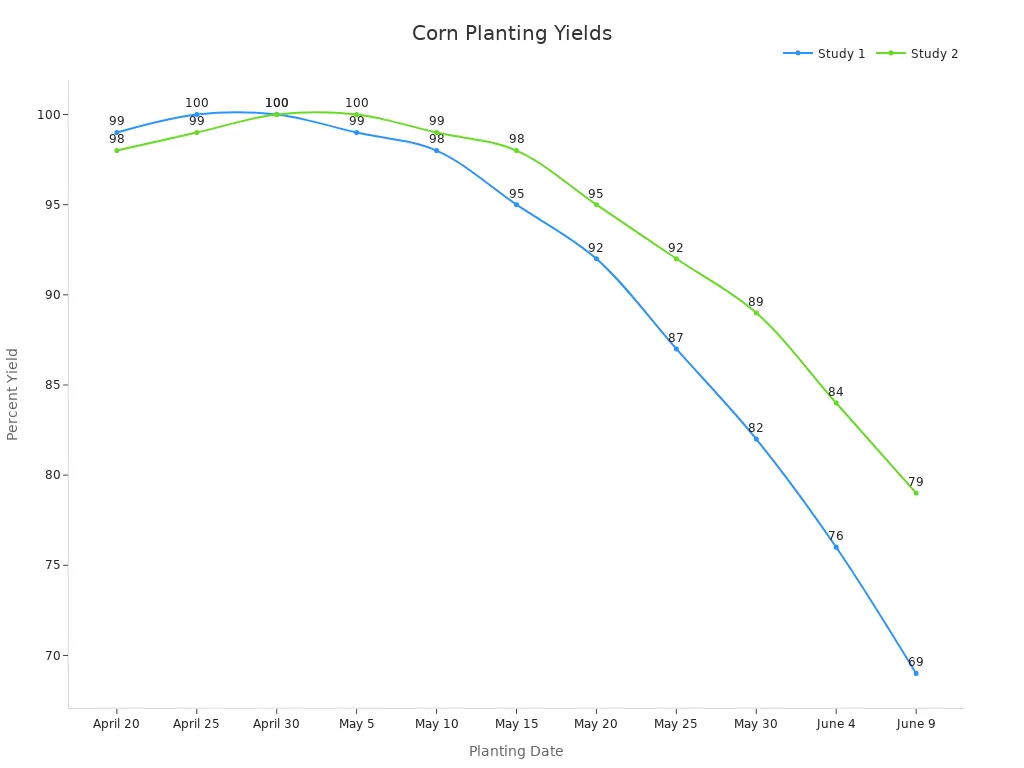
Planting after May 15 reduces yield potential by about 0.4% per day. If you wait until June, you risk losing up to 30% of your yield. Always check the weather forecast and soil conditions before planting to avoid frost damage or waterlogged soil.
Pro Tip: Use a soil thermometer to monitor temperatures. Planting when the soil is warm ensures better germination and healthier plants.
Step-by-Step Guide on How to Plant Corn Seeds
Planting corn seeds doesn’t have to be complicated. Follow these steps to ensure professional results:
- Prepare the Soil: Make sure the soil is loose, well-drained, and rich in nutrients. Add organic matter or fertilizer if needed.
- Mark Rows: Use a string or marker to create straight rows. This helps with spacing and makes it easier to manage your crop later.
- Plant the Seeds: Place seeds at the recommended depth (see the next section for details). Cover them with soil and press gently to ensure good seed-to-soil contact.
- Water Immediately: After planting, water the area to keep the soil moist. This helps the seeds germinate faster.
- Monitor Growth: Keep an eye on your seedlings. Look out for pests, weeds, or diseases that could harm your crop.
By following these steps, you’ll set your corn up for success from the very beginning.
Spacing, Depth, and Watering Tips
Proper spacing and depth are crucial for healthy corn growth. Here’s what you need to know:
| Study | Planting Depths | Key Findings |
|---|---|---|
| Ohio State Study (2020) | 1 inch, 2 inches, 3 inches | Shallow planting led to faster emergence but reduced uniformity. Deeper planting improved yield in high organic matter fields. |
| Univ. of Missouri Study (2021) | 2.5 to 3 inches | Deeper planting resulted in better emergence uniformity, especially in warm conditions. |
| Oklahoma State Study (2015-2018) | 1.5 inches, 2.5 inches | Planting at 2.5 inches consistently increased yields compared to 1.5 inches. |
- Depth: Plant seeds 1.5 to 2.5 inches deep. Deeper planting works better in warm soil, while shallow planting may cause poor root development.
- Spacing: Space seeds 30 inches apart in rows. This allows each plant to get enough sunlight, water, and nutrients.
- Watering: Keep the soil moist but not waterlogged. Studies show that minor irrigation adjustments can boost yield by 3-5% while reducing water use by 40%. Delay irrigation until two weeks before tasseling for optimal results.
Note: Overwatering can harm your plants. Stick to a consistent watering schedule and adjust based on rainfall.
By planting at the right depth, spacing your seeds correctly, and watering wisely, you’ll create the perfect environment for your corn to thrive.

How to Grow Sweet Corn After Planting
Post-Planting Watering and Fertilizing
Watering and fertilizing are key to growing sweet corn. Corn needs steady water, especially during tasseling and ear growth. Give it 1 to 1.5 inches of water weekly. If it’s very dry, increase to 2 inches. Deep watering helps roots grow strong. Shallow watering can weaken plants.
Nitrogen is very important for corn growth. When plants are 12 inches tall, add nitrogen-rich fertilizer beside them. Do this again when tassels appear. Yellow leaves mean your plants need more nitrogen. Fertilizers like fish emulsion can fix this quickly.
Keep soil moist during silk emergence. This is when kernels form, and dry soil can cause smaller ears. By watering and fertilizing well, your corn will grow strong.
Pro Tip: Use a rain gauge to check weekly water levels. This prevents overwatering or underwatering.
Managing Weeds, Pests, and Diseases
Weeds, pests, and diseases can harm your corn if ignored. The first 4–6 weeks are critical. Weeds steal water and nutrients from your corn. Remove them often or use mulch to stop their growth.
Pests like corn borers and rootworms are common problems. Choose pest-resistant seeds like Bt corn to reduce damage. Insecticide-treated seeds also protect young plants. Check your field often to spot pests early. If pests are too many, use insecticides as needed.
Diseases like rust and blight can hurt your crop too. Rotate crops every two years to lower disease risks. Foliar fungicides can also protect your plants and boost yields.
| Strategy | Description |
|---|---|
| Hybrid Selection | Use Bt corn for pest resistance. |
| Seed Treatments | Protect young plants with treated seeds. |
| Scouting | Check fields often for pests and damage. |
| Insecticide Applications | Use insecticides only when pest levels are high. |
| Cultural Practices | Rotate crops and plant early to avoid pests. |
| Weed Control | Remove weeds to stop pests and viruses. |
| Tillage | Till soil to reduce pest buildup. |
Stay alert to keep your corn healthy and growing well.
Note: Early pest control prevents big losses. Act fast to protect your plants.
Monitoring Growth and Troubleshooting Issues
Watching your corn grow is important for a good harvest. Corn grows in stages, from planting to tasseling and silking. Each stage needs special care. For example, during V6 to V7, plants need lots of nitrogen for fast growth.
Here’s a simple guide to growth stages by Growing Degree Days (GDDs):
| GDDs | Estimated Growth Stage |
|---|---|
| 0–70 | Planting to Emergence |
| 71–140 | Emergence to V1 |
| 141–195 | V1 to V2 |
| 196–255 | V2 to V3 |
| 256–300 | V3 to V4 |
| 301–355 | V4 to V5 |
| 356–415 | V5 to V6 |
| 416–490 | V6 to V7 |
| 491–565 | V7 to V8 |
| 566–645 | V8 to V9 |
| 646–695 | V9 to V10 |
| 696–770 | V10 to V11 |
| 771–840 | V11 to V12 |
| 841–890 | V12 to V13 |
| 891–935 | V13 to Tasseling |
| 936–1050 | Tasseling to Silking (R1) |
| 1051–1190 | Silking to Blister (R2) |
| 1191–1345 | Blister to Milk (R3) |
| 1346–1400 | Harvest |
Technology can help you monitor growth. Satellites measure plant greenness and moisture. Drones give detailed views of plant health and problem areas.
If you see stunted growth or yellow leaves, act fast. Check for pests, diseases, or missing nutrients. Fixing problems early saves your crop and improves yield.
Pro Tip: Use drones to find problem spots in your field. This saves time and effort.
By watching your corn closely and solving issues early, you’ll grow sweet corn like a pro.
FAQ
What’s the best way to store leftover corn seeds?
Store seeds in a cool, dry place. Use airtight containers to keep moisture out. Proper storage ensures seeds stay viable for the next planting season.
How do I know if my corn seeds are still good?
Perform a germination test. Place seeds on a damp paper towel, keep them warm, and check for sprouts after 5–7 days.
Can I plant corn seeds from last year’s harvest?
Yes, but only if they’re properly dried and stored. Hybrid seeds may not produce the same quality crop, so consider certified seeds for better results.